viernes, 2 de julio de 2010

Tegucicalpa

Most people avoid Tegucicalpa or at most spend just one night there before taking the first bus out. It has the reputation for being inhospitable and rough town rival into the city did nothing to dispel this impression, as everything in the area I was staying shut down by 8pm and my little hotel locked the doors for entry and exit from 10pm. So it was into dead streets that I sallied forth that first night and the only restaurant open was Wendy's. Dinner was 2 hamburgers in the dismal neon light. At the street corners humans and dogs were vying with each other sifting through the mounds of refuse and apart from them and the odd vagrant in a doorway only one or 2 people could be seen leaving the area purposefully. The dogs were looking for food and the humans for aluminium and glass and plastic bottles for which they would get recycling money, as well as for food. No life, a sense of emptiness and lawlessness. Maybe I have a very bad impression based on the limited view from one district. Staying in downtown Harare would be similarly dismal. This is the capital city where the embassies have their offices, but perhaps too, as in Harare, the rich live behind high walls and frequent restaurants and night spots also behind similar walls or shopping malls with good security. I was determined to go the Museum of National Identity, which was reputed to be very interesting and good. After wandering around the market of Comayaguela and attending to some bureaucracy I went to the museum only to find that all governmaent offices were closing as the national team were playing their last game, against Switzerland. I had a hissy fit, as I did not want to stay in that hole for another 2 nights, and the security guards just laughed at me. In the end, I figured that football was very much part of the national identity and I didn´t have to go to the museum to see a live demonstration. The travel agent where I went to book my onward journey to Nicaragua was a bit like Kathy my old boss at Exec Air and she was just as dramatic and eloquent about extolling the virtues of Honduras. Except she didn't live in the town centre either and her daughters lived in Europe... Nevertheless, I thought at least I could try to get this blog up to date and see the museum too...

In the event, I was glad that I was there for the game, virtually everyone was engaged and very proud that they managed to deny Switzerland a chance in the last 16, giving a chance for a fellow Latin American team to qualify (Chile). I watched the first half in burger king and the 2nd partly in the main square, but then heard the passionate shouts from the internet café (as I did not feel like being pickpocketed again). Although I had been given the address of a decent restaurant, somehow it always seemed too late to go to the other side of town because of the lockup time of the hotel. So I ate something like 8 hamburgers in 2 days....

The Museum was definitely worth a visit. The whole bottom floor was dedicated to the national football team, so I got that in one. There was a great virtual tour of Copán which was a good review and reminder having seen the real thing, an ordinaire art exhibit, but the real meat was a vast display of the history of Honduras from 300 million years ago to the present day (excluding the coup)

Here I learned that Honduras was G-d's gift to humanity, as when the tectonic plate shifted the land mass that became Honduras into position, it closed the isthmus joining the 2 Americas, diverted the Gulf Stream northwards and so moderated the climate, changing many of the rainforests of Africa into savannah and allowing the chimps to come down from the trees, which gave rise to humans and of course, football. Without Honduras, no humans, and definitely no football.

This tectonic movement created mountain ranges distinct from Guatemala as they are due to wrinkling of the earth's crust rather than volcanic activity. So settlements were in isolated pockets, and the country was never part of an empire or extended kingdom. So it was with the conquest, the faction from Mexico entered via Guatemala, anothe faction entered via Costa Rica and the 2 slugged it out to try to establish their own spheres of influences, founding city states and garrisons to mark out territory, many of which did not survive to the preset day. There were 3 motives for holding the land. Gold as ever, the dream of uniting the Atlantic to the Pacific to create a new trade route to Asia, and farming. The English put paid to the idea of using Honduras as part if a trade route as the ports were too difficult to defend, being continually overrun by British and or pirates. The church did not have much luck here either, as the indigenous rightly associated the missionaries with bearing lethal disease, so they killed them or shunned them when they could. The miracle is that the Catholic church is so widespread and devoutly followed today.

Other than that, the history is one of opportunism. Take aviation for example. Seen as the great hope of finally uniting the country as numerous attempts at a trans coastal route had failed, the Honduran Government bought a Handley Page 9 in 1921 and hired an English ex-WW I pilot (Ivan Lamb) to fly it. He promptly pranged it. So that was that until 1924 when an American mercenary (Frank Brown) was hired to fly bombing raids on the capital in a violent change of government. In 1931 an enterprising New Zealander Lovell Jerex pitched up with a plane, established a parcel service charging $4 per kilo in 1931 money a whopping figure, which must be the equivalent of hundreds today. His Honduran license was handwritten on a sheet of ledger paper with an official stamp. (Although who was competent to test him, lord knows, as there were no pilots in Honduras) When Carias need help to depose the government prior to setting up his own dictatorship, Jerex put his aircraft at his disposal, lost an eye in active service, and was therefore granted monopoly rights and the right to import 4 aircraft a year plus spares duty free in recognition of his services. A similar story of mutual backscratching is linked to the establishment of banana and palm oil plantations. And so to the present day as privilege from patronage competes with the aspirations of the poorer people. The recent coup favoured entrenched privilege. It's an ongoing tension in Latin America.


The sign on the bus door, no weapons, no consumption of beverages, no smoking
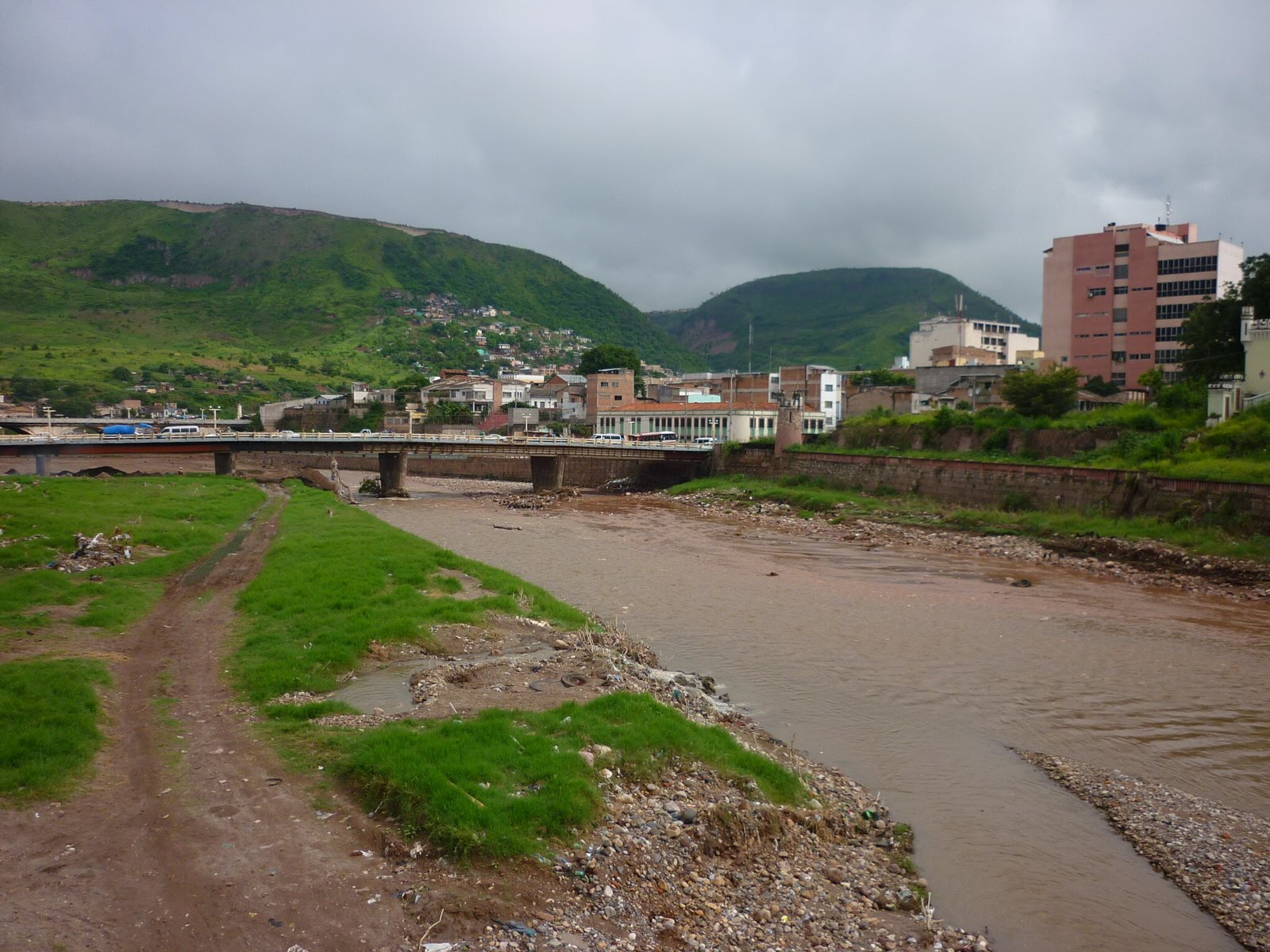
The view of Tegucicalpa from Comoyaguela

One of the many markets of Comayaguela. Within the rabbit warrens of wooden stalls teamed with life, but I was reluctant to get a camera out

An arty café I found during my wanderings around town on the first afternoon after the football match. A relief to have found some normal life, a place with atmosphere where I could finally buy a cold beer... Until this happened....

When I walked into the café above, a group of students were partying around the table. I turned around when they called "Hey Meester" They asked me to kiss one of the girls there on the lips, I did and then asked them "What did she win?" It was a dare for a drink apparently. 15 mins later I was asked to kiss another, this time a long kiss... I said I only would if they took this picture. She can't have been much more than 18, with braces. Can't see why it was exciting to kiss a grizzled foreigner. As you can see she's proudly wearing a Honduras shirt. However, I declined to join their table as I didn't want to be their foreign mascot, but it was evidence of some kind of raucous sense of humour. I had the feeling that the culture here was of a brash macho kind

A beautiful old colonial building

The palpable national pride at not allowing the Swiss through nor conceding a goal

La Iglesia de la Virgen de las Dolores at the end of the street of my hotel

jueves, 1 de julio de 2010

Diving Roatan

I had heard that the coral reefs of Roatan were amongst the most beautiful in the Carribean and that diving in the Bay Islands in the North of Honduras a real must. Initially the toss up was between Utila (cheaper courses) and Roatan itself (where although more expensive, the west coast lies in a protected maritime national park). 6 of 1 and half of the other as I had also heard that the marine life in Utila was good. In the end I chose Roatan, partly to evade the possibility of drunk backpackers and also because of the better coral reefs. As the bay islands and the north of Honduras had been British for many years, whilst Sir Francis Drake and of course the pirates were giving the Spanish a poke in the eye, predominantly English is spoken here. There is a large garifuna or ex-slave population, so it has a don't worry, be happy west indian feel.

Everything in Roatan is expensive, partly because everything has to be brought by ferry from the mainland about 35km away but also being a captive audience, we had to pay whatever was asked... Even the local supermarkets were outrageous and the only place to buy food reasonably was at the hypermarket at the other end of the island. There was a shared kitchen at the hostel, but it took ages to cook anything because the gas pressure was so low, and the limited utensils meant having to try to coordinate with the other guests.

The 2 restaurants that I liked there were "Creole Kitchen" run by a local woman of english descent (although she assured me that she didn't have pirate blood in her) and a fancy desdigner restaurant owned and run by Italians that would not have been out of place in Camps Bay. Although there menu in general was pricey, they had a special of 2 lobster tails for just $12, very tastey. Although I did feel guilty about eating them, as they are such beautiful creatures in the wild and they are now being overfished like crazy. Local garifuna youths are recruited, given SCUBA equipment with minimal training and sent to collect as many as they can. The result, a decimated lobster population and scores of young men crippled as they over dive to depths far to deep, without any safety stops and get the bends. Too much of this and the body never recovers.
As for Creole Kitchen, one can eat just so much roast chicken in a week....

But the diving itself was gorgeous, and barracuda plentiful as well as numerous turtles, lobsters, a king crab at depth and huge Grouper fish by the Aguila wreck, around 37 mts so tame you could almost touch them. Inall, I dived with 3 different companies, Native sons, Bluewater Adventures and Reef Gliders. As Native Sins was closing the day after I arrived, I did my advanced PADI with them in a bit of a rushed fashion, but the dive instructor David was great fun and very good with knowledge of flora and fauna of the reef, having dived the area for the past 6 years. Bluewater adventures were brilliant, the individual attention gave me a chance to improve my diving technique, fix buoyancy issues that had not been addressed in my peak performance buoyancy course, and both Lee and Jason took me on beautiful long dives exploring parts of the reef I had not yet seen. Reef Gliders hsd s grest social life and was also a very professional outfit. I joined them for a night dive (too much moonlight, shame) and a dive the next day. The experience was enhanced by having Michelle as my buddy.. she is an amazing diver who can last what seems like forever on a tank of air, and her forte is taking photographs underwater. You can see some of them on various of her posts on http://www.apeppercloud.blogspot.com but the real joy is that she is a great singer and musician, and a couple of evenings we experimented with me playing for her singing as well as singing together. It was really beautiful and great fun.

The view looking down the "street" where Chillies Hostel/Native Sons are situated

A closer look at the building on the right above. Jimmy, a large jovial black man has his own hostel and church and travel business all run out of the same window. He had a flair for florid oration

Half moon Bay, West End. our local beach, complete with hungry mozzies and sand flies

West Bay, where the rich American holiday makers hang out

The exposed coral at the end of West Bay

My trusty steed (on which I explored the island for a day) with East End behind, not as popular or as pretty as West End (ring any bells?)

The east side of French Harbour where a lot of the poor people live

A bay close to Oakridge on the south east side of the island

One of many iguanas around that area, don't know if they were all escapees from the local iguana farm

Looking west towards Sandy Bay and West End

The crew at Native Sons getting the boat ready before a dive

A beery debrief at Native Sons/Chillies

Swimming through the hoop for Peak Performance buoyancy....

This time with a smile...

With the England flag on the mooring line (forget who they were playing that day) and a photogenic jack helpfully swimming by

miércoles, 30 de junio de 2010

Copán Ruinas

I arrived in Copan in torrential rain. As is usual the streets themselves had turned to rivers, and the preferred hotel was full, so it was back to living in a dormitory in a backpackers hostel. The next day the sky had cleared somewhat and I walked with an American family to the ruins which were just over 1km away from the edge of town. We shared the costs of hiring a guide, which made it quite affordable. It was however, the most expensive site that I have visited. The entrance ticket alone to the whole site and museum around US$40 and the guide cost another US$10, although I think this was down to the negotiating and Spanish skills of the father. The deal had been done without consulting me.

Every time I visit Mayan ruins, there is a feeling of peace, mostly caused by the consciousness of the passing eons as the jungle has entwined itself around many of the structures, and the natural rock on the sculptures and pyramids is complemented by the lush green vegetation. However, when this was a living city, it would have been bery different; instead of grass around the structures, the whole would have been paved with stucco, and plastered with the same, and been predominantly blood red with details picked out in ochre, green and blue. The environmental impact of covering over the fertile valley with this impermeable layer, coupled with the vast amounts of firewood needed to anhydrate the limestone has been touted as a reason for this city state's collapse, as the farmers were driven up on to the hillsides, where the soils were poorer and became even worse with the soil erosion. On top of this, the loss of the trees probably altered the rainfall patterns making it even harder to eke out a living. Even so, the magnificence if the sculptures and the decoration if the buildings is beautiful and moving.

Macaws, emblems of Copán very colourful with the most awful raucous cry, a complete contrast to the plumage. They are fed here , but are free to fly around.

The statue of the vision serpent, manifest dirung festivals and sacrifices most visibly as smoke from the burnt offerings. However, they would carry in their mouths the apparition of the ancestors who were bid to appear

The tranquil North Plaza

Sacrificial stone over which the human offering would be splayed with his back arched, whilst the priest king would cut out his heart or decapitate him with an obsidian blade. Note the gulley for the blood to run off and be collected before being mingled with copal incense and burned.

A "tree" as alluded to in the "Forest of Kings". The Mayans believed that trees were the links between the underworld and the gods and spirits in the sky, and the stelae were seen as equally important spiritual bridges between the 2 worlds

A beautiful Macaw's head adorning the building at the top of the eastern side of the ball court

The famous hieroglyphic staircase, now protected giving details of the provenance of the dynasty of the ruling family. 18 Rabbit commissioned many such monuments to legitimise his rule. The large figures on the treads comprise the long line of kings from the beginning of the the dynasty. The glyphs apparently talk about rituals too, but our guise although claiming to be able to read them, didn't deign to enlighten us. (He also claimed to be a descendant of the last Mayan king, but with only an oral record for the last millenium, my guess he's about as related as the average greek waiter is to Aristotle) 18 Rabbit met with an unfortunate end, as the client ruler he installed in Quirigua eventually turned on him, captured his patron and sacrificed him, subjugating Cop'an for a time.

Detail from a bench. Note the figure in the foot of the bench bearing the weight.

A picturesque strangler fig, with completely hollow trunk

Detail of a bat with cojones. Bats were symbols of power, terror and death

An intricate stone carving of a pelican with a fish in its beak

Figures dotted around the patricians' meeting place


A king's eye view of the ball court with heiroglyphic staircase on the right.

The mighty Ceiba tree which now occupies the king's seat

Xela to Antigua again

Being a native Cancerian, I become very attached to people and places and so it was with Xela, I had enjoyed my time there at the school enormously and the family that I had been billeted with in the homestay very simpatico. Martha our surrogate mother took pains to talk to us frequently and correct our Spanish. It was a valuable part of the experience, but even the knowledge that I might be able to land myself a weekly gig playing at a local café and that I had finally found the best venue to dance salsa were not sufficient in themselvs to delay the onward journey.

So I commanded a magic carpet a.k.a. chicken bus, to take me to Antigua, and on a grim and rainy afternoon I said goodbye to Xela as we were whisked away. We just made it in time to Chimaltenango for the last connecting bus, and while we were waiting we were greeted by this sight of a bored little boy amusing himself squashing his nose and making funny faces in the adjacent us.


Once again I was back in the cosmopolitan melee of Antigua, and during supper at Rainbow Cafe was entertained by a passionate political conversation with 2 girls from New York. It cheers me up that there are so many engaged and thinking Americans, curious about the world and travelling; not just the ignorant bigots that Fox news would have us believe populate the USA.

I spent the night at Umma Gumma hostel, and the next day was invited to breakfast by a friendly group who had prepared far too much to consume themselves. Again very bright, alive young people. The one guy Sam in the middle of a medical degree, but taking time to learn foreign languages so that he could eventually work for Médécins sans Frontières, and had just got engaged to his Columbian girlfriend via Skype, a Canadian girl who had lost all her money and travel documents (but who was very cheerful and hospitable nevertheless) and an American girl who was finishing a proficiency exam in Spanish prior to setting up a language school for infants in Washington D.C.

But the real gift of Antigua this time, is that in the early morning I was finally able to see the mountains and volcanoes that surrounded the city; all had been obscured by the swirling cloud for weeks.

The main street below from the roof terrace

Volcan Agua with a lenticular cloud forming at the tip

Volcan Fuego

Fot the sake of completeness the rest of the 360 degree survey, looking behind he hostel.

martes, 29 de junio de 2010

Tajamulco

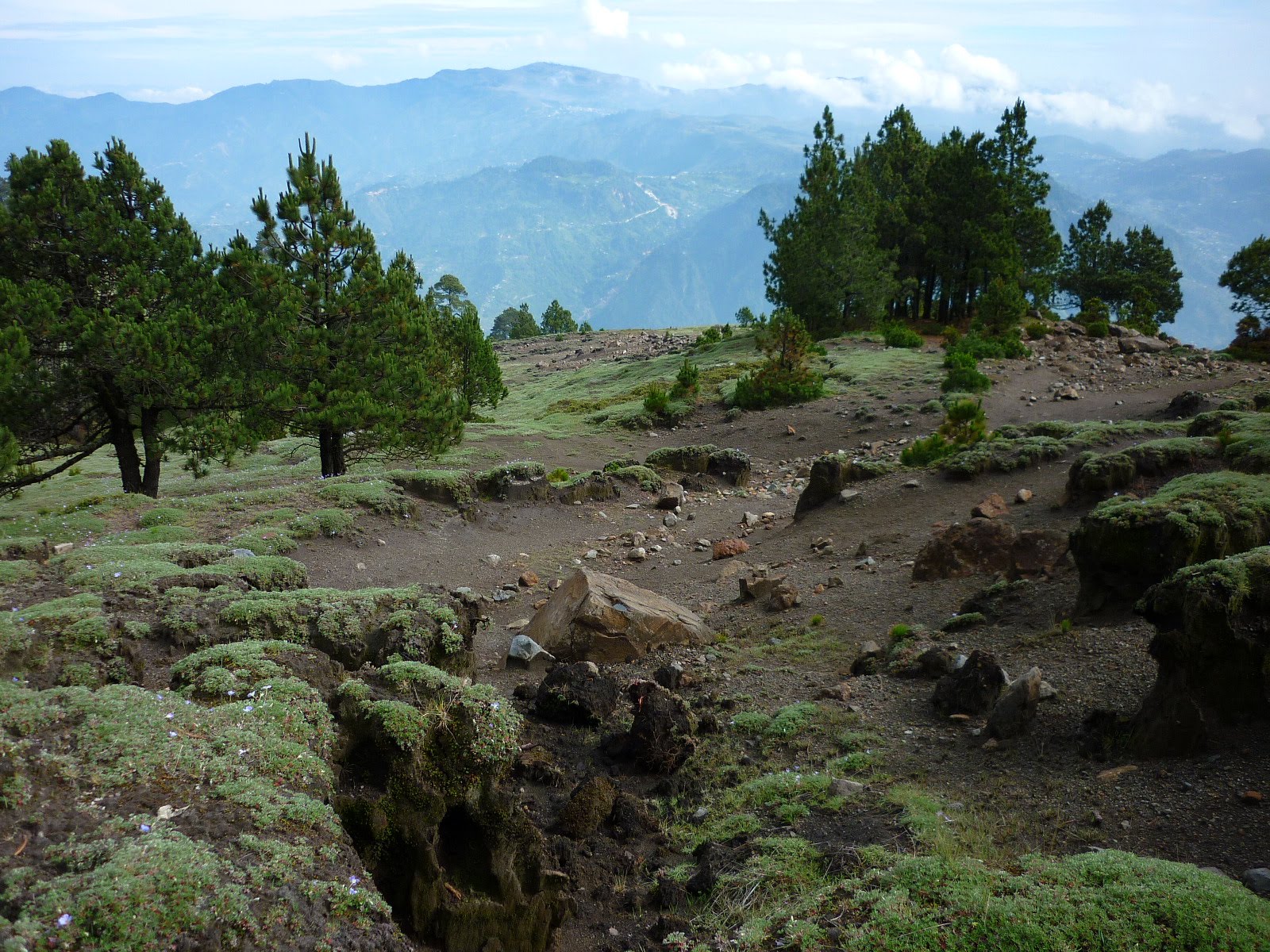
I was lucky enough to have the opportunity of a 2nd shot at climbing Tajamulco, having passed up the trip the previous weekend. However, the rain returned and in the hope it wasn't another tropical storm, I set off with an American couple and our guide, Saul who had walked with me to the top of Santa Maria.

Unfortunately when we arrived at the start of the walk, this was the sight that greeted us; drifting fog and cloud, and a tropical storm was esconced over the Yucatan trailing this clag for hundreds of miles. Anyway, we were now committed and we just prayed that there would be a break in the weather for us. It had been 2 chicken bus rides and a 3 hour trip time to get this far and the lack of visibility was made up for the by the electric performance of a patent medicine vendor. In the more affluent world, we are continually bombarded by advertising on television and on billboards, but here the advertising is done in person, whether by people proclaiming their wares from the marketstalls or to captive audiences on the bus. The strategy is to terrify the audience and then offer salvation in a bottle. This particular gentleman started his patter by extolling the virtues of the oesophagus, and pointing to members of the hapless audience, quiz those of us who hadn't managed to evade his beady eye on various dubious healthcare points. "What is the oesophagus for? "
"It connects the mouth to the ....?"" Stomach! Very bright, belleza!!"
" What happens if you don't care for the oesophagus, sores on the mouth and....?" ( at this point a laminate folder of terrible mouth and throat sores is produced and the various ailments are described in suitably reverent and hushed tones..."Ulcers!! Belleza muy listo es!!"
" And if you don't treat these ulcers what happens?" " You don't know?!!!!" " What!!?" "You get cancer, that's what!!!!"
" But if you take a teaspoonful of these salts in half a glass of water every morning with your breakfast your oesophagal tract will be cleaned and you won't get ulcers and you won't get cancer, and if you have it already, this will clear it up."

Bottles of this stuff are then handed out to everybody to inspect and hold this magic medicine in their own hands.
"Normally this costs 100 Quetzales, but for you and today only as an introduction I'm prepared to accept not 50, not 20 but 10 Quetzales, and look it's made in Guatemala City where all the big businesses are, so that shows that the manufacturers are serious!"
On inspection, there was not a single ingredient listed on the label, but a Guatemala city address, a fancy name and the directions for use which I've already described. But the charisma and the attire (Cowboy hat and boots and a cellphone brandished like a six shooter of yore) and the swagger of this man were totally engaging and watchable. When the show was over, he collected money from those who believed and the bottles back from those that didn't, waited for his spot and got off, waiting to board some bus to terrify another hapless group on the return journey.

The depressing weather that greeted us at the foot of Tajamulco

An indignant turkey marking his territory at the last line of dwellings

A nascent magic mushroom on the day of the start

The next day.... my how you've grown!

Mike and Elana during a rest stop.

The weather deteriorated as we started our ascent and Mike and Elana were struggling with altitude sickness, so the race was on to pitch our base camp before the storm hit, as we needed to make frequent stops for them to recover. (Mind you, I didn't complain) Thunderclaps were getting more frequent and ever closer. Saul our guide was patient and brilliant. When we got to our camp, the edge of the tree line at 4000mt he immediately strung a line between 2 pine trees, over which he threw a giant plastic tarpaulin which we secured to make a sloping roof. Being the tallest in the group it fell to me to secure the lines, and as the rain started to pelt down, Elana was brilliant at helping to pitch and organise the tents as she was a veteran of many a camping trip with her Dad when she was younger. (Apparently he had his kids pitch tents against the clock) Meanwhile I was given the machete to dig a ditch around our roof, so that the draining water didn't enter the tents. Totally the wrong tool, but I was proud of my effort at altiude, striking sparks against buried stones, cutting through roots; I'm just gutted that I didn't think of taking a photo of it, quite a feat of civil engineering in adverse conditions. If you want to read Mike and Elana's version of the adventure, you can read it on their blog here: http://www.travelpod.com/travel-blog/mikeandelana/1/tpod.html
Both of them were suffering from headaches and nausea by the end of it, so it was left to just Saul and me to admire the view of the afterglow of the sunset. The west was completely overcast, but the view to the east was magical, with the illuminated clouds contrasting with the volcanoes of Xela.

A stroke of good luck, the cloud cleared to the east at sunset giving this superb view of Santiaguito erupting (yet again!) at the foot of Santa Maria

Saul the guide with the peak of Tajamulco in the background, It was absolutely freezing cold by this time, and I was wearing 2 t-shirts a sweatshirt, a fleece and an overcoat!

Dawn breaking at the summit 4220mt, the following morning at about 0500, the tripod frame to the left of the photo was the remnants of a radio relay antenna used by the guerillas during the civil war which ended only in 1996 which cost some 200 000 lives in 34 years.

Daybreak.

The peak of Tacana in the mystical morning light

Tacana still wearing her veil as we start the descent.

A clear window showing the volcanoes of Antigua on the left of the horizon Agua, then the double peaked Acatenangoand then Fuego, on the right the volcano of Xela, Santa Maria, the cone.

The cloud beginning to spill pver the ridge on the way down.

Looking back at the summit.

The locals take horses up the mountain to log firewood, with the tragic result that without the tree roots to bind the soil to the mountainside, it gets washed away causing the erosion of these deep gullies in the side of the mountain.

Saul at the head of a gully

The unusual luxury of having a seat all to myself in a chicken bus, Normally we were crammed 3 to each seat, sometimes more.

A flock of chicken buses